Hi, I’m Shenqi. I’m a final-year undergraduate in Biomedical Engineering at Zhejiang University. Since May 2026, I’ve also been a research intern at the National University of Singapore, working with Prof. Dianbo Liu. I’m interested in AI for healthcare and in evaluating LLMs and AI agents.
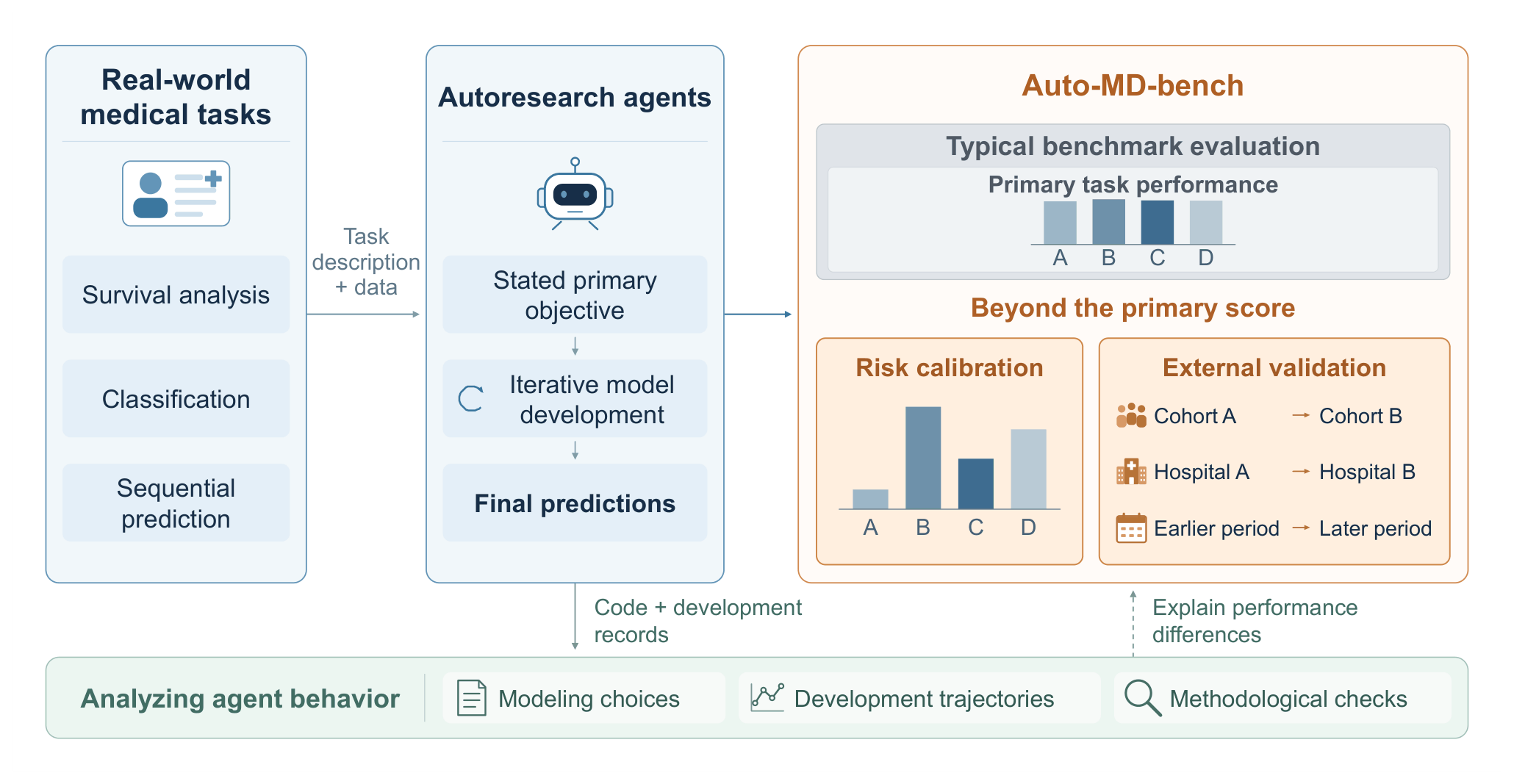
My current project, Auto-MD-bench, evaluates autoresearch agents on medical prediction tasks. Before that, I worked with Prof. Nai Ding at Zhejiang University, comparing how people and LLMs understand Chinese sentences.
We find that the strongest agents score higher than simple baseline models on the main metric, but their models’ risk estimates are less well calibrated than those of the baselines. The models’ performance also varies across patient populations.
Figure 1. Overview of Auto-MD-bench.
Research
Auto-MD-bench
– present
Research intern at the National University of Singapore, advised by Prof. Dianbo Liu
I led an independent research project investigating whether optimizing a single performance metric is sufficient to guide autoresearch agents toward models for real-world medical use. I designed and built Auto-MD-bench, which covers survival analysis, classification and sequential prediction tasks, with external validation across patient populations. I also evaluated the calibration of the agents’ models and the modeling choices the agents made.
Evaluating Chinese sentence understanding in large language models
–
Undergraduate researcher at Zhejiang University, advised by Prof. Nai Ding
I led a team of three students investigating how well LLMs understand Chinese sentences and how their sentence spaces compare with those derived from human judgments. We collected entailment judgments from people and LLMs on a set of Chinese sentences we created. The LLMs agreed closely with people on semantic relatedness but much less on entailment direction.
Course projects
Skin lesion classification on HAM10000
Spring 2026
Biomedical Image Processing course, Zhejiang University · Team lead (five students)
Our team built classifiers for seven types of skin lesions in dermoscopy images. I reviewed everyone’s work and combined it into the final report. My own part was the evaluation and error analysis, for example looking at melanomas that the models misclassified as benign nevi.
Reading Footprints
Fall 2025
Advanced Programming course, Zhejiang University
I built a web app for reading and note-taking (Flask, SQLite) that opens TXT, Markdown, PDF and EPUB files and keeps each note next to the passage it belongs to.
Education
Zhejiang University
– (expected)
B.Eng. in Biomedical Engineering · Hangzhou, China
Selected courses: Probability and Mathematical Statistics, Linear Algebra, Introduction to Pattern Analysis and Machine Learning, Data Structures and Algorithm Analysis, Advanced Programming, Biomedical Signal Processing
Programming: Python, C · AI tools: Codex, Claude Code